 how-to
Replacing an Oil Heat Pump: Steps, Costs, and Rebates
Last Updated: October 30, 2026
Quick Summary
To replace oil heat pump systems, first run a room-by-room load calculation, then check whether your ducts, radiators, and electrical panel can support a heat pump. Confirm utility rebate pre-approval and installer eligibility before installing, and get every cost and incentive itemized in writing.
- Ask for a room-by-room Manual J load calculation rather than a square-footage estimate.
- Settle distribution compatibility, such as ducts or radiators, before signing, since it often changes the budget.
- Confirm the electrical panel capacity in writing before the install date is set.
- Utility rebates usually require pre-approval, so apply before installation begins.
- Ask for an itemized quote separating equipment, electrical, oil tank removal, and rebates.
Table of Contents
- Oil Furnace vs. Heat Pump: What You Are Replacing
- Checking Home Suitability and Heat-Loss Before You Switch
- Heat Pump Installation Requirements: Radiators, Ducts, and Electrical Service
- Oil to Heat Pump Conversion Process, Step by Step
- Oil Tank Removal After Heat Pump Installation
- Heat Pump Rebates, Incentives, and Financing Options
- Booking Your Oil-to-Heat-Pump Replacement With BB O CONSTRUCTION CORP & HVAC
- Frequently Asked Questions
Oil Furnace vs. Heat Pump: What You Are Replacing
If your home runs on heating oil, a replace oil heat pump project is a bigger job than a simple swap. An oil furnace or boiler burns fuel to make heat, while a heat pump moves heat from outside air or the ground into your home. That difference changes how the system is sized, how it is installed, and what else in the house has to change.
For most people, the main reasons to switch are rising oil costs, the hassle of fuel deliveries, and the desire to cut carbon emissions. Heat pumps also provide cooling in the same system, which an oil heating system cannot do.
Checking Home Suitability and Heat-Loss Before You Switch
Before you choose a heat pump for your replace oil heat pump project, you need to know how much heat your home loses. A heat-loss assessment, sometimes called a Manual J load calculation, measures how much heating the house needs on the coldest days.
Start with the basics:
- Age and condition of insulation in walls, attic, and crawl spaces
- Window type and air leakage
- Number of floors and the size of each room
- Recent renovations or additions
Sizing matters. An undersized heat pump struggles on cold nights, and an oversized one cycles on and off, wasting energy and wearing out faster. Ask your installer to show the calculation rather than simply quoting a unit size. Our guide on which heat pump models hold up in cold winters covers the options for homes like yours.
Heat Pump Installation Requirements: Radiators, Ducts, and Electrical Service
Most homes that heat with oil use radiators or hot water baseboard. Others have forced-air ductwork. Each setup affects your options.
- Ducted homes: Existing ducts may work with a heat pump, but they need to be sized and sealed correctly.
- Radiator and hydronic homes: Air-source heat pumps can supply heated water, but the radiators may need to run at lower temperatures. Some homes need larger radiators or a different distribution approach.
- Ductless mini-splits: These suit homes without ducts, including older buildings, and they can heat individual rooms or zones.
Check your electrical service too. A heat pump draws more power than many older homes can supply without an upgrade. Ask an electrician to confirm your panel capacity before the install date.
Oil to Heat Pump Conversion Process, Step by Step
Most guides list the steps. Few explain what actually has to be true before each step can start, which is where conversions stall.
Step 1, Room-by-room load calculation (Manual J). Do this before any quote. A whole-house square-footage rule of thumb will oversize or undersize the unit. Ask for the room-by-room output, the design outdoor temperature used, and the assumed insulation and air-leakage values.
Step 2, Distribution compatibility check. This is the step that most often changes the budget, so settle it before signing:
- Ducted homes: Have the ducts measured for static pressure and leakage. Older duct systems are frequently undersized for the higher airflow a heat pump needs, and leaky ducts in unconditioned space waste capacity. Common fixes are sealing, adding returns, or upsizing trunk lines.
- Hydronic baseboard and radiators: Measure the existing emitters and compare them to the lower supply water temperatures a heat pump produces. Rooms with undersized baseboard may need larger emitters, added panels, or a hybrid approach that keeps the boiler for the coldest weeks.
- No ducts, no hydronics: Ductless mini-split heads per zone are usually the path, with one outdoor unit serving multiple indoor heads.
Step 3, Electrical service audit. Confirm the panel's available capacity, the service amperage, and the distance from the panel to the outdoor unit location.
Step 4, Oil system decommissioning plan. Decide the order of operations so the house is never without heat.
Step 5, Tank decision. Emptying, cleaning, and removal versus abandonment in place is a separate scope item with its own rules and its own cost. Get it quoted as a line item, not bundled into 'miscellaneous.'
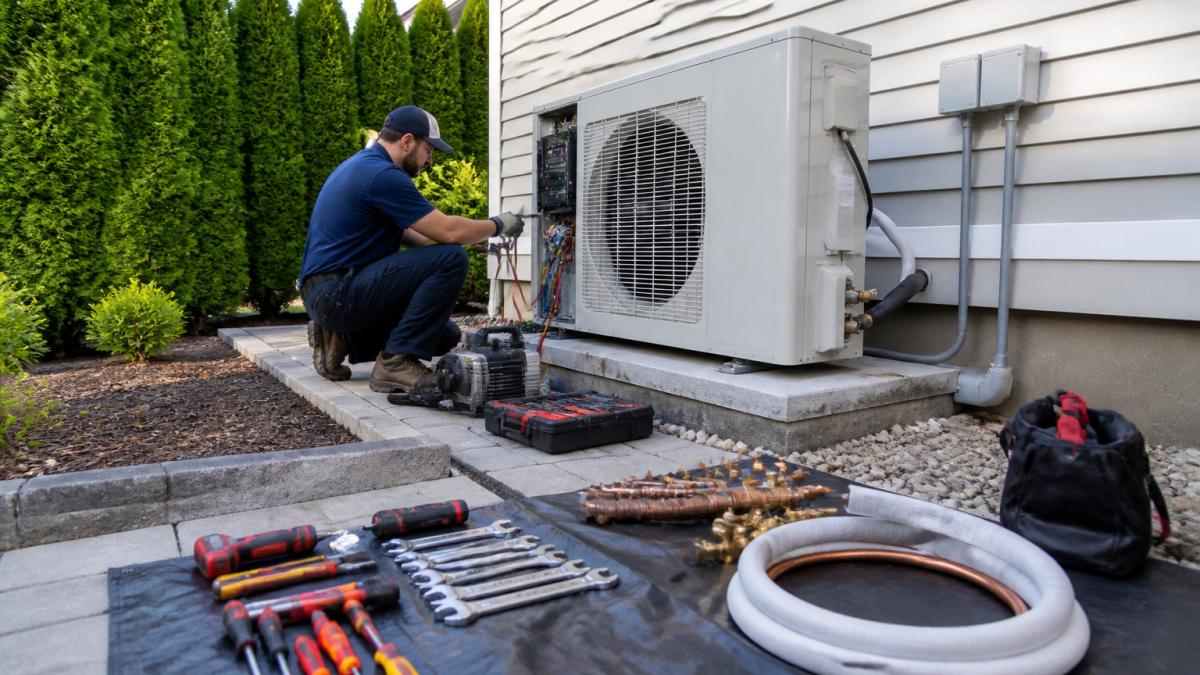
Step 6, Installation and refrigerant/line-set work. Outdoor unit placement matters for defrost drainage, snow clearance, and noise. Confirm the pad or wall bracket, the line-set route, and condensate handling before the crew arrives.
Step 7, Commissioning and performance verification. Do not accept 'it's running' as done. Ask for:
- Airflow or water-flow measurement against the design values
- Supply and return temperature readings at design conditions
- A balance report if the system is zoned
- The configured backup-heat lockout temperature and the defrost settings
- A walkthrough of the thermostat or controls, including how to switch to emergency heat
Step 8, First-season tuning. Expect a follow-up visit after the first heating season to adjust flow temperatures, balance zones, and review runtime data. A system that was set up in October often benefits from retuning in January.
Oil Tank Removal After Heat Pump Installation
Once the oil burner is disconnected, the tank has to be dealt with. Ask the contractor who handles emptying, cleaning, and removal, and whether the price includes disposal. Old tanks can leak, so check the tank and the soil around it for contamination. If you find oil residue, you may need an environmental assessment, which can add cost and time. Keep records of the removal in case you sell the home later.
Heat Pump Rebates, Incentives, and Financing Options
Incentives are the part of an oil-to-heat-pump conversion that changes fastest and gets explained worst. Most guides tell you to 'check with your utility' and stop there. Here is the practical version for homeowners in Long Island, New York City, and Westchester.
Utility rebates through PSEG
Utility incentive programs may be available for qualifying heat pump replacements, and amounts depend on program rules, equipment, and home details. Program terms and eligibility are updated periodically, so the number that matters is the one on your written quote, not a figure from a blog post. Two rules of thumb that hold across most utility programs:
- Pre-approval usually comes first. Many rebates require the application to be submitted and approved before installation. Installing first and applying later is the most common reason homeowners lose an incentive.
- Installer participation matters. Some programs require the work to be done by a participating contractor. Confirm your installer is on the approved list before you sign.
Combined savings with our company's additional rebates
On top of the utility incentive, we offer additional rebates of our own on qualifying conversions. The exact combined figure depends on the equipment selected, the home's current heating system, and program eligibility at the time of the quote, so ask for it itemized in writing.
Financing options
We are not a bank, and financing is provided through lending partners, so approval and terms are set by the lender, not by us. What we can tell you about the current paths:
- Financing is available through lending partners for qualified applicants. Terms, rates, and promotional periods vary, and approval depends on credit and the lender's criteria.
- Lease-to-own arrangements may be available for some applicants through participating providers.
All financing is subject to credit approval and lender terms. Ask for the full agreement, the annual percentage rate, the promotional period end date, and the retroactive-interest language before signing anything.
Federal and state incentives
Beyond the utility and company rebates, federal residential energy credits and state-level programs may also apply to qualifying heat pump installations. Eligibility depends on equipment efficiency ratings and the home's situation. Confirm current status on the IRS and Department of Energy sites, and ask your contractor to list every incentive they are claiming on your behalf in the quote.
How to compare quotes fairly
Ask every contractor for a quote that separates:
- Equipment and labor
- Electrical work and any panel upgrade
- Distribution changes (ducts, emitters, or additional heads)
- Oil tank removal or abandonment
- Utility rebate applied for, with the approval reference
- Company rebate applied
- Financing terms, if used
A quote that folds rebates into a single 'discounted price' hides whether you are actually getting the incentive or just a marketing number. The itemized version is the one you can compare.
The table below lists the incentive and financing facts stated in this section, so you can compare them against your written quote.
| Incentive or option | Stated detail | Condition |
|---|---|---|
| Utility rebates (PSEG) | Amount set by program rules and equipment | Pre-approval usually required |
| Company rebates | Added on top of utility incentive | Depends on equipment and eligibility |
| Financing | Set by lending partners, not by us | Subject to credit approval and lender terms |
| Lease-to-own | May be available through participating providers | Applicant eligibility varies |
| Federal and state credits | Depend on equipment efficiency ratings | Confirm on IRS and DOE sites |
Booking Your Oil-to-Heat-Pump Replacement With BB O CONSTRUCTION CORP & HVAC
BB O CONSTRUCTION CORP & HVAC handles oil-to-heat-pump replacements, from the load calculation through installation and commissioning. Ask for a written quote that itemizes equipment, labor, electrical work, oil tank removal, and any rebates that apply, so you know exactly what you are paying for. Contact the team for a free estimate.
If you want the full details on local rebate programs, see our guide to Long Island heat pump rebates or our page on timelines and budget commitments before you book.
Frequently Asked Questions
Is it worth replacing a 30-year-old oil furnace with a heat pump?
Often, yes. Oil furnaces commonly reach the end of their service life around that age, and repairs become more frequent and costly as components wear. A heat pump can provide both heating and cooling in one system, and it can lower operating costs depending on your fuel prices, home insulation, and the efficiency of the equipment you choose. A professional heat-loss assessment and a side-by-side comparison of your current annual heating costs will show whether the switch makes financial sense for your home.
What should I check before switching from oil heat to a heat pump?
Start with a heat-loss assessment to determine the heating capacity your home needs. Then check your existing radiators or ductwork, your electrical service capacity, and your insulation and air sealing. Confirm whether your home will need supplemental or backup heat during the coldest days. Ask your installer to review these items in writing before you commit, so the replacement is sized and planned for your specific house rather than a generic estimate.
What happens to the oil tank when you switch to a heat pump?
Once the oil system is no longer in use, the tank should be emptied, cleaned, and removed by a licensed contractor, or properly closed and abandoned if removal is not practical. Leftover oil and sludge can contaminate soil and groundwater, so do not leave a tank in place without a documented decommissioning plan. Ask your installer whether they coordinate tank removal and keep records of the work, and check local requirements in your town before the work begins.
What rebates are available when replacing oil heat with a heat pump on Long Island?
Utility rebates may be available for qualifying heat pump installations, and BB O CONSTRUCTION CORP & HVAC can offer additional rebates that may be combined with those utility incentives, depending on your equipment and eligibility. Amounts vary by project and program rules, so confirm current eligibility before you sign a contract. Our team can help you review the paperwork for qualifying programs.